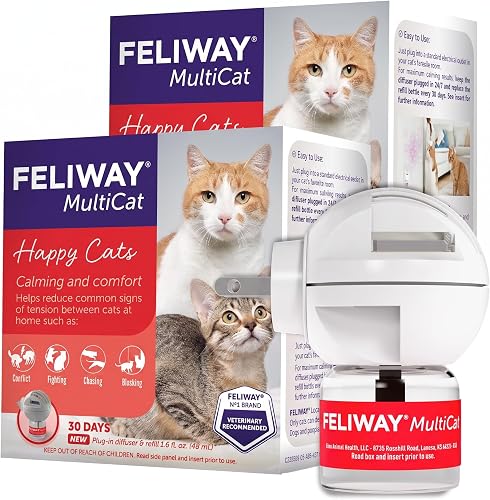
Rival cats? The FELIWAY MultiCat Calming Diffuser targets that friction.
Your cat lives under the bed now, a patch of belly fur is thinning, and there is pee beside the box. That is what cat stress tends to look like. Six steps to calm it, vet check first.
Book a vet check if she stops eating, strains in the box or pees outside it.
Write down anything new at home lately: people, pets, furniture or your hours.
Give her a quiet room with everything she needs inside it, plus somewhere to hide.
Keep meals, play and lights-out on the same clock every day.
Add height: A cat tree or a tall post in the room she uses most.
Rival cats hissing or chasing? Add a FELIWAY MultiCat diffuser where their paths cross most (see FELIWAY MultiCat at Amazon).
Hiding, overgrooming, skipping the box: the stress tells
A stressed cat rarely makes a scene. The signs of a stressed cat are quieter: she hides more, grooms one spot bald, skips the litter box, snaps at someone she used to like, or eats differently.
Your cue: any one of those after a change at home (a move, a new pet, a new person, a new schedule) means it's time to look for the trigger. A scratching post gives a stressed cat an outlet; see our scratching and climbing picks.
Why the vet goes first: a cat in pain can hide, stop eating or miss the box, the very same signs stress causes. Only your vet can tell which one you are dealing with.
The picks side by side
Pick
Best for
The catch
Our pickFELIWAY MultiCat Calming Diffuser Starter
Best forTension between cats
The catchIt works with enough litter boxes and resting spots, not instead of them. Keep one box per cat plus one.
Also greatGardner Pet 41" Tall Cat
Best forLarge cats
The catchNeeds assembly
Also greatANWA 32" Tall Cat Scratching
Best forCats that scratch standing up
The catchIt's a post, not a tower. Climbers who nap up high want a cat tree.
Why stress looks like sickness
A 2011 JAVMA study (Stella, Lord and Buffington) followed 32 cats for 77 weeks: 12 healthy, 20 with a bladder condition. In weeks with routine changes, like a new caretaker, both groups were much more likely to show "sickness behaviors": eating less, going outside the litter box and similar signs. The healthy cats were affected about as much as the sick ones.
So "she's fine, she's just being a cat" can miss a real problem in either direction.
Signs to watch
Hiding more: Under the bed, in the closet, skipping meals to stay hidden. Some hiding is normal; more than usual is the signal.
Litter box changes: Going outside the box, or going more or less often. Stress can cause it, the ASPCA says, and so can illness, so it is vet first, every time.
Overgrooming: Licking one area until it thins or goes bald, often the belly or legs.
New grumpiness: Hissing, swatting or biting, especially from a cat who used to be friendly.
Appetite changes: Eating a lot more or a lot less. A cat who stops eating needs a vet call, not a wait-and-see.
Voice changes: More meowing, night yowling, or a talkative cat gone quiet.
Scratching new places: The door frame, the new couch, the spot near where the new dog sleeps.
Tense body language: A low crouch, tail wrapped tight or tucked, ears turned sideways or flat, pupils wide in a bright room. A relaxed cat sprawls; a worried one stays folded up and ready to bolt.
Find the trigger
Ask what changed in the last few weeks. The usual suspects:
The house: A move, renovation, new furniture or even a rearranged room.
The household: A baby, a partner, a new cat or dog, a roommate leaving.
The routine: A new work schedule, travel, boarding, guests. A carrier that stays out all week makes trips less of a surprise: see our cat carrier picks.
Too few resources: Several cats sharing one box, one bowl, one good window.
Boredom: An indoor cat with nothing to stalk.
Keep a one-week stress log to spot the pattern
The trigger is not always obvious. For a week, jot down each sign you notice (a hiss, a missed box, an afternoon under the bed) and the time. Add whatever else was going on: a visitor, the vacuum, a strange cat at the window.
A pattern often shows up on paper that you miss day to day: trouble every evening the dog comes in, or every time the washer runs. Bring the log to the vet visit too. It turns "she seems off" into something the vet can work with.
How to help a stressed cat
Quiet base: One calm room with food, water, a litter box and a place to hide. Let your cat come out on their own schedule. Dragging a cat out from under the bed teaches them the bed was right.
Go up: A cat tree like the Gardner Pet 41-inch, with two condos, top perches and sisal posts, gives a nervous cat a lookout above the room. It needs some floor space; if you don't have it, a tall scratching post like the 32-inch ANWA still gives them a full stretch and a place to claim. It has no perch on top, though.
Boring routine: Same feeding times, same box locations, same bedtime. Predictable is calming.
Daily play: A short wand session or two a day lets your cat hunt, burn off nerves and end on a win. Our cat interactive toy picks keep the hunt going. The 15-minute wand routine is laid out step by step.
Multi-cat homes:The ASPCA's rule: one litter box per cat, plus one extra. Add separate food bowls, more than one water spot, and enough perches and hiding places that nobody has to share. If the cats are hissing at or chasing each other, the FELIWAY MultiCat diffuser is made for that tension. Plug it in where they spend the most time. Cat snubbing the water bowl? Try the moving-water fix.
The catch: Each refill runs 30 days, so put the next swap on the calendar.
Skip it if: Your cats already get along. The kit is made for homes where they hiss and chase.
Common mistakes
See the 7 pointsHide this section
Skip these
Dragging your cat out from under the bed: it teaches them the bed was right. Let your cat come out on their own schedule.
Waiting it out when she stops eating: a cat who stops eating needs a vet call, not wait-and-see.
Brushing off litter box changes: stress and illness look a lot alike in cats, so it's vet first, every time.
Making cats share: several cats sharing one box, one bowl and one good window is a stressor. Give them separate bowls and enough perches and hiding places that nobody has to share.
Counting on the diffuser alone: the FELIWAY MultiCat diffuser works alongside enough boxes and space. It doesn't replace them.
Scolding the accident or the hiss: it adds one more thing to fear and can teach her to steer clear of you. Clean the spot with an enzyme cleaner and move on.
Changing everything in one week: new food, a moved box and a new diffuser all at once make it impossible to tell what helped. Change one thing, then watch.
Still stressed after the fix: what to check next
You found the trigger, set up the quiet room and kept the routine dull, and she is still on edge. Work through these before you change anything else.
Look outside: a strange cat in the yard or on the sill can keep an indoor cat on guard all day. A closed blind or frosted film on the lower pane is an easy thing to try.
Check the routes: each cat should reach food, water, a box and a resting spot without walking past the cat she is avoiding. If a box needs to move or a new one goes in, see our picks for litter box smell.
Reread the log: a new pattern after the first fix usually points to a second trigger hiding behind the first.
Go back to the vet: ask whether pain could still be part of it, and whether a referral to a veterinary behaviorist or anti-anxiety medication makes sense for your cat.
When to call your vet
See the 5 pointsHide this section
Your cat stops eating.
Blood in pee or poop, or straining in the box.
Overgrooming that leaves sores or bald patches.
A big personality change, like friendly to aggressive.
Signs that don't ease after you've found and fixed the trigger.
Verdict: rule out illness, then make home predictable
Stress signs are your cat telling you something shifted. Clear illness with your vet, name the trigger, then hand her a quiet room, a high perch and a day that runs the same way every time. Rival cats get the MultiCat diffuser on top of that setup.
How long does it take a stressed cat to calm down?
It depends on the trigger. A rearranged room can pass quickly; a move or a new cat usually takes longer, and a slow introduction is part of the fix. If the signs don't ease once the trigger is handled, book a vet visit.
Can stress make a cat pee outside the litter box?
Yes. Stress can do it, and so can a bladder problem or other illness, which is why the vet visit comes before anything else. Once she is cleared, look at what changed and at the box itself: where it sits, how clean it is and how many there are.
Will a calming diffuser fix a stressed cat by itself?
Rarely. The FELIWAY MultiCat diffuser is built for friction between cats, so it fits homes where they hiss and chase. It does its job next to enough boxes, bowls and perches. For one cat upset by a move or a new baby, start with the quiet room and the routine.
Should I comfort a cat who is hiding?
Yes, on her terms. Sit nearby, talk softly and leave a treat at the edge of the hiding spot, then let her come to you. Reaching in or pulling her out makes the hiding spot feel more necessary, not less.