The best puzzle toy for most dogs is the Nina Ottosson Dog Brick, a Level 2 puzzle with sliders, flip lids and lift-out bones. It's hard enough to hold an adult dog's interest and easy enough that a first-timer won't quit. If your dog has never used a puzzle, start with a snuffle mat or a stuffed, frozen treat toy and move up from there.
In this guide
How we picked: specs, difficulty levels and the job each pick does. Below are four core picks, two picks for specific jobs, a difficulty ladder, free DIY puzzles and the safety rules to follow.
Puzzle toy difficulty levels explained
Most puzzle toys are rated by difficulty level. Understanding these levels helps you pick the right challenge for your dog:
Level 1 (Beginner): simple hide-and-reveal mechanics; great for puppies and puzzle newbies
Level 2 (Intermediate): multiple steps required, like sliding AND flipping; ideal for most adult dogs
Level 3 (Advanced): complex sequences that require strategic thinking; best for experienced puzzle dogs
Level 4 (Expert): multi-step, combination challenges for dogs who have mastered everything else
Start one level below where you think your dog is. Build confidence before increasing difficulty.
Best puzzle toys by difficulty
Here is the ladder, from the easiest win to the hardest puzzle. Move up a rung only when your dog finds the current one easy.
Beginner: snuffle mat
Sprinkle kibble or treats into the fabric folds and let your dog sniff and root them out. It copies foraging, slows down fast eaters and is easy for any dog, which makes it a good fit for senior dogs. Our snuffle mat pick is below.
Beginner: KONG Classic, stuffed
Rubber in several sizes, and you can fill it with almost anything (peanut butter, kibble, banana, yogurt). Set the difficulty with the filling:
Easy: Kibble plus peanut butter
Medium: Frozen peanut butter, banana and kibble
Hard: Layer peanut butter, freeze, add kibble, freeze again
A frozen fill lasts longer than a loose one, so freeze it when you need your dog busy for a while.
Intermediate: lick mat
Fill it: Spread peanut butter, plain yogurt, pumpkin puree or wet food into the grooves, and freeze the toppings for a longer session. Suction versions stick to the floor or a wall.
Good for: Storms or nail trims. A lick mat gives your dog something to do while it passes.
Intermediate: Nina Ottosson puzzle boards
Sliding, flipping and lifting parts teach your dog to work a problem, and the range comes in several designs and levels. Move here once your dog empties a stuffed KONG without trouble. Our pick, the Dog Brick, is covered below.
Advanced: West Paw Toppl, doubled up or frozen
The open design is easier than a KONG at first, but two Toppls fit together for a much harder challenge, and a frozen fill slows things down again. The wide mouth is easy to reach into when you rinse. For a mechanical puzzle at this level, see the Trixie Activity Flip Board below.
Also great
Trixie Activity Flip Board
Best for: Advanced puzzle solvers, smart breeds like Border Collies and Poodles
Why we picked it: it asks for two kinds of moves (slide and flip) plus lift-out bones. That is enough to hold an adult dog's interest without the frustration of a Level 3 or 4 puzzle.
Pros: Right difficulty for most adult dogs. Multiple challenge mechanisms.
Cons: Smart dogs crack it fast: rotate in a harder one. Not chew-proof, so supervise every session.
Skip it if: Your dog chews plastic when frustrated. The lift-out bones are the first part to go, so stay in the room.
What makes it stand out:
Level 2 intermediate difficulty provides a real challenge without frustrating your dog
Three types of treat-hiding mechanisms: sliding, flipping, and removable bones
Designed by Nina Ottosson, whose puzzle range is sorted into levels so you can move up as your dog improves
22.Best for brainy breeds: Trixie Activity Flip Board
Best for: Advanced puzzle solvers, smart breeds like Border Collies and Poodles
The catch: Compact board: big dogs find it fiddly
Skip it if: You have a large dog with a big muzzle.
Why we picked it: sliders, flip lids and lift-out cones on one board give a dog who breezes through simpler puzzles several problems to solve in one session.
Pros: Three mechanisms on one board. Includes training guide. Rubber feet. Great for brainy dogs.
Cons: Runs small: big dogs need a bigger one. Cones can be chewed if unsupervised.
Skip it if: You have a large dog with a big muzzle. The compartments are small, and the cones are easy to chew off.
What makes it stand out:
Multiple challenge types on one board: sliders, flip-top lids, and lift-out cones
Rubber feet on the base
Includes a training booklet with tips for introducing each mechanism
Compact design fits easily on any floor or table surface
Hard plastic board that wipes clean between sessions
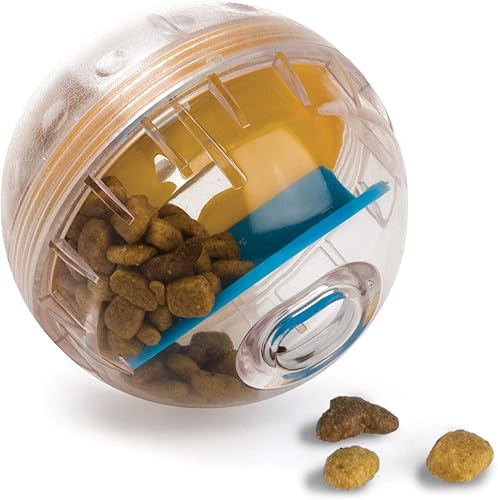
33.Best for mealtime: Pet Zone IQ Treat Ball
Best for: Turning meals into a puzzle, slowing down fast eaters
The catch: It rattles on hard floors. Roll it out on a rug for quieter mornings.
Skip it if: Your floors are hard and you feed late at night.
Why we picked it: it mixes a puzzle with squeaky toys. Your dog pulls plush squirrels out of the trunk, which suits dogs who ignore hard plastic puzzles.
Pros: Wins over dogs who ignore plastic puzzles. Combines puzzle and squeaky play. Multiple sizes available. Replacement pieces available.
Cons: Plush material won't survive aggressive chewers. Squeakers can be removed and swallowed.
Skip it if: Your dog pulls the squeakers out of toys. Pick the squirrels up after every session.
What makes it stand out:
Combines puzzle-solving with squeaky toys: two kinds of play in one toy
Soft plush, which suits gentle players
Available in multiple sizes from Junior (XS) to Ginormous (XXL)
Replacement squirrels are sold separately, so a chewed squirrel doesn't mean a new toy
An indoor-friendly way to let your dog hunt for treats
Picks for specific jobs: nose work and frozen fillings
Two more toys earn a place for one job each: sniffing out a meal, and a frozen filling that keeps your dog busy while you get something done.
55.Best for nose work: Outward Hound Snuffle Palz snuffle mat
Best for: Puzzle beginners, senior dogs, fast eaters, and anxious dogs who settle by sniffing
The catch: Fabric is fair game for aggressive chewers, so supervise
Why we picked it: hiding kibble in fabric strips puts your dog's nose to work, and sniffing is real work for a dog. It's the easiest puzzle on this page to start with.
Cons: Fabric: keep it away from power chewers. Messy with wet food; stick to kibble or dry treats.
Skip it if: Your dog chews fabric toys apart. Pick the mat up as soon as the food is gone.
What makes it stand out:
Fabric strips hide kibble and treats at different depths, so you can make it easier or harder
Machine washable: Toss it in and let it air dry
Works with any kibble or dry treat
66.Best for frozen fillings: West Paw Toppl treat toy
Best for: Frozen treat enrichment, owners who want an easier-to-stuff alternative to a KONG
The catch: Quick to empty. Freeze it for a longer job.
Why we picked it: the wide opening makes it quicker to stuff than a KONG, and the soft inner ridges hold peanut butter and frozen food in place. Buy it if you freeze fillings often and are tired of packing a narrow KONG.
Cons: Not indestructible for power chewers.
Skip it if: Your dog is a power chewer. A classic KONG in the right size is the tougher choice.
What makes it stand out:
Wide opening is easier to stuff than a traditional KONG, which saves prep time
Two sizes fit together for a harder puzzle
Made from Zogoflex, a bouncy, recyclable material
Freezer and dishwasher safe, and BPA-free
How to get the most out of puzzle toys
Puzzle toys work best when used with a plan. These habits keep them interesting:
Rotate puzzles every few days. Novelty is what keeps interest up.
A simple rotation: KONG and snuffle mat for a few days, puzzle board and lick mat for the next few, then bring back a toy that has been put away.
Use a mix of treats. Hiding different rewards keeps your dog guessing and motivated.
Start each new puzzle with treats visible and easy to access, then increase difficulty
Supervise the first few sessions to ensure your dog plays safely
Combine puzzle types: Alternate between sliding puzzles, rolling balls, and plush puzzles
Use puzzle time as a replacement for one daily walk when weather or schedules don't cooperate
A puzzle toy before bed helps energetic dogs wind down for the night
Other good times: Just before you leave the house, at mealtimes instead of a bowl, and during storms as a distraction.
How to introduce enrichment toys
Start easy and let your dog win in the first minute. A dog who gets stuck early often walks away from the toy for good.
Use the easiest setting first, with treats in plain sight, so the first win comes fast.
Start with high-value treats (cheese, freeze-dried liver), then switch to kibble once your dog gets the idea.
Stay in the room for the first sessions and make sure your dog is playing, not taking the toy apart.
Serve one meal from a snuffle mat or treat ball instead of a bowl. For wobbling and rolling dispensers such as the KONG Wobbler, compare treat-dispensing toys.
Match the difficulty to your dog. If they walk away, make it easier; if they finish in a minute, make it harder.
A progression to try, moving up once your dog finishes the current level without help:
Start: Easy puzzles (loose kibble in a KONG, treats on a snuffle mat)
Next: Medium (a frozen KONG, puzzle boards)
Later: Hard (a layered frozen KONG, advanced puzzles)
Don't start hard. Frustration kills interest faster than boredom does.
Stuffing and Freezing Ideas
For stuffable toys like the West Paw Toppl and a KONG, freezing the filling makes the same toy last longer. Freeze it solid; overnight in the freezer is the easy way.
Peanut butter and banana slices. Check the label first: the peanut butter must not contain xylitol (sometimes listed as birch sugar), which is toxic to dogs.
Plain, unsweetened yogurt and blueberries
Wet dog food and kibble, layered and frozen for the hardest version
Plain pumpkin puree (not pie filling) and a few training treats
Bone broth frozen as a base layer, topped with peanut butter. Use a broth made for dogs, or one with no onion or garlic.
Count the filling as part of the day's food so the extras don't add up. For flat toppings, see these lick mat recipe ideas.
DIY puzzle toys (free options)
Want to test whether your dog likes puzzles first? These use things you already have. Stay in the room for all of them.
Muffin tin puzzle: Put treats in a muffin tin and cover the holes with tennis balls. Your dog lifts the balls to find the treats. Use balls too big for your dog to swallow.
Towel roll: Roll treats up in a towel. Your dog unrolls it to find them.
Box puzzle: Put treats in small boxes inside a larger box, and your dog digs through to find them. Remove tape and staples first.
Frozen washcloth: Wet a washcloth, fold treats inside and freeze it. Your dog chews to get the treats. Take it away once the treats are out, because swallowed fabric can cause a blockage.
Puzzle toys by dog size
Not all puzzle toys work for every size dog. Here's a quick guide:
Small dogs: The Pet Zone IQ Treat Ball and Nina Ottosson puzzles in small sizes
Medium dogs (20 to 50 lbs): check each listing for the size that fits
Large dogs (50 to 80 lbs): choose large-sized versions of the Hide-A-Squirrel and larger IQ Treat Balls
Giant breeds (80+ lbs): look for XL or Ginormous sizes; standard puzzles are too small for them
Safety Notes
Supervise at first: Watch how your dog handles each new toy before you leave them alone with it.
Size it right: A toy or ball that is too small is a choking hazard.
Check for damage: Replace torn plush and broken puzzle pieces.
Avoid rawhide inside puzzles (a choking risk), and never use grapes, raisins or anything with xylitol as a filling.
If your dog swallows a piece of a toy, call your vet.
Yes, with the right type. Start with Level 1 puzzles and soft plush options like the Hide-A-Squirrel. Avoid hard plastic puzzles until your puppy is past the intense teething phase (around 6 months). Always supervise puppies with any toy and remove small parts that could be swallowed. Until then, pick puppy teething toys made for sore gums.
How long should enrichment sessions last?
Daily is a good habit. Let the toy set the length: a snuffle mat or loosely filled toy is done in minutes, while a frozen stuffed toy lasts longer. There's no need for a timer: stop when the food is gone or your dog walks away, then pick the toy up.
Are puzzle toys safe to leave with my dog unsupervised?
Not at first. Watch a few sessions to see how your dog treats each toy. Pick up plastic puzzles, plush toys and snuffle mats when you leave. A tough rubber stuffable toy is the usual choice for alone time, once you know your dog doesn't chew pieces off it.
My dog ignores puzzle toys. What should I do?
Your dog probably needs an easier starting point. Place high-value treats (cheese, hot dog pieces, freeze-dried liver) on top of the puzzle so they get instant rewards. Once they understand treats come from the toy, gradually hide them. Some dogs also respond better to certain puzzle types: if a sliding puzzle doesn't click, try a rolling treat ball or a snuffle mat instead.
Our Verdict
Buy the Nina Ottosson Dog Brick Puzzle Toy if your dog is ready for more than a snuffle mat. Its slide, flip and lift-out steps hit the right difficulty for most adult dogs, session after session.
For brainy breeds that need more challenge, the Trixie Activity Flip Board has the most variety. The Pet Zone IQ Treat Ball is the simple way to make every meal a puzzle. The Hide-A-Squirrel suits dogs who would rather pull out squeaky toys than push sliders. For nose work, pick the Outward Hound snuffle mat; for long frozen fillings, the West Paw Toppl.
Also great
Trixie Activity Flip Board
Best for: Advanced puzzle solvers, smart breeds like Border Collies and Poodles
Whatever you buy, start one level easier than you think and rotate. A setup to start with: one stuffable toy, one foraging toy and one mechanical puzzle.
Still deciding? Get this one.
Nina Ottosson Dog Brick Puzzle Toy
Best for: Dogs ready to level up from beginner puzzles, building problem-solving confidence