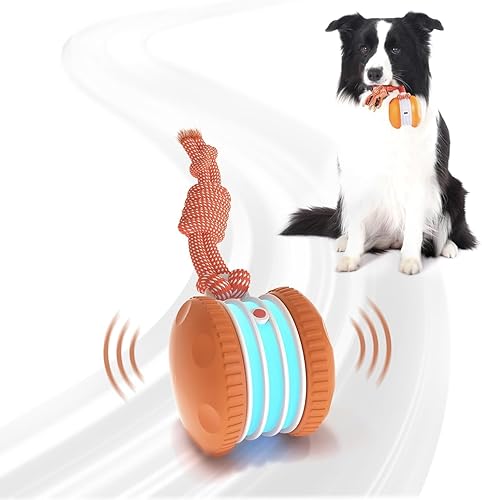
Turn the QGI Interactive Dog Ball off and roll it by hand until he follows it, then switch it on at the slow setting while you stand well back.
Reward calm watching, not bravery.
In this guide8 sections
He sniffed the ball, it rolled off on its own, and he left the room. Switch it off, let him meet it as a plain ball, and turn it on only from a distance. Five steps:
Set the ball on the floor, switched off. Let him sniff it at his own speed, treat any curious look, and never push his nose at it.
Roll it by hand like any ball. Praise and treat when he follows it.
Switch on the QGI Interactive Dog Ball (see it at Amazon) on slow while you stand on the far side of the room. Treat him for watching calmly, and come closer only when his body looks loose.
When he steps toward it, let him go. Stay in the room and watch.
Stop after a few minutes, while he still wants more. Switch it off and put it away until the next session.
Backed off at any step? Go back one step and stay there for a session or two. That is not a failure; it is the pace that works.
What you need
An open room with the low furniture cleared out. The ball rolls a random path, so give it space.
A handful of small, soft treats he loves, small enough to eat in one bite.
A calm window of five minutes, and you in the room with the treats in your palm.
A charged ball. It charges over USB-C, and a ball that stalls halfway through step 3 teaches him nothing.
The catch
The fast speed is for energetic dogs, so start a nervous dog on slow.
The picks side by side
Pick
Best for
The catch
Our pickQGI Interactive Dog Ball
Best forSmall, medium and large dogs
The catchNot for aggressive chewers
Also greatSilveWillo Interactive Rolling Ball
Best forCats and small dogs
The catchLess durable than premium options
Also greatTRECKPET Treat Dispensing Dog Toy
Best forFood-motivated dogs
The catchStart on the easy setting so he keeps playing, and roll it out on a rug to keep the noise down.
Calm or worried: read him before each step
A ball that moves with nobody touching it breaks the one rule he knew about balls: they wait for you. His body tells you whether he has made peace with that yet.
Ready for the next step: loose body, soft tail wag, sniffing the ball, a play bow, taking treats without snatching.
Stay where you are: he watches it hard but stays put, ears up, body still. Give him time before you move on.
Go back a step: tucked tail, ears pinned, lip licking, yawning, refusing treats, or walking out of the room.
A dog who won't take a treat he normally loves is telling you the session is too much. Switch the ball off, toss him a few treats away from it, and end there.
Mistakes that make a self-moving ball scary
See the 5 pointsHide this section
Skip these
Forcing him to stay near it. Let him choose.
Leaving him alone with it on day one. Watch the first sessions while he learns it.
Long sessions. Short and happy beats long and wild.
Switching it on right next to him. The first time it moves, it should be far enough away that he can watch it without needing to escape.
Laughing or cheering when he jumps back. Stay quiet and boring; your calm is the cue that the ball is nothing to worry about.
Still ignoring it: three things to change
The timing. Try after a walk, when he is relaxed instead of wound up.
The toy. Heavy chewer? The QGI is not made for aggressive chewers, so see our interactive toy picks.
Some dogs simply prefer a ball you throw. If he chases a hand-rolled ball happily but never warms to the moving one, that is a fine place to stop.
From scared to wild: when he overdoes it
See the 3 pointsHide this section
Some dogs flip fast, from hiding behind the couch to barking and pouncing on the ball. Keep the game, lower the volume.
Barking at it: Keep it on slow, and treat the quiet moments while it rolls.
Pouncing and pinning it: let him chase the rope attachment instead, which gives him something to follow besides the ball itself.
Carrying it off to chew: trade it for a treat, switch it off, and pick it up. Chewing time is for a chew toy.
Before each session, look the ball and rope over. A cracked shell or a frayed rope means it comes out of rotation.
Our pick for a nervous dog: QGI Interactive Dog Ball
Best for a cautious dog: The QGI has a slow speed made for timid pups and a fast one for when he is ready. The same ball grows with his confidence. A smart sensor starts play, then it rolls a random path, with a rope attachment to chase. It is listed for small, medium and large dogs, and once the circling turns into a chase, he has a game even when you are on a call. The catch: it runs on a charge, so top it up before every training session.
Skip it if: He destroys toys. It isn't built to survive a determined chewer.
How long does it take a dog to accept a moving ball?
Go at his pace. If he backs off, go back to step 1. The slow start is what gets you a dog who chases it.
Can I leave it on while I am out?
Not while he is learning. Stay in the room for the first sessions, and keep every session short in an open room.
Why is my dog scared of the self-moving ball?
It moves when nothing is touching it, and that's the part to take away first. Ball off, roll it by hand, and switch it on only once he follows a hand-rolled ball.
Why does my dog bark at the moving ball?
Barking can be worry or excitement. A stiff body and backing away means it is still too close; a play bow and a waggy rear end means he wants to play. Either way, slow speed and short sessions help. More signals to watch for are in our guide to reading dog body language.
What if he is scared of other new things too?
The same slow approach works for most new objects. If he is fearful of many everyday things, or the fear is getting worse, ask your vet; they can rule out pain and point you to a trainer.