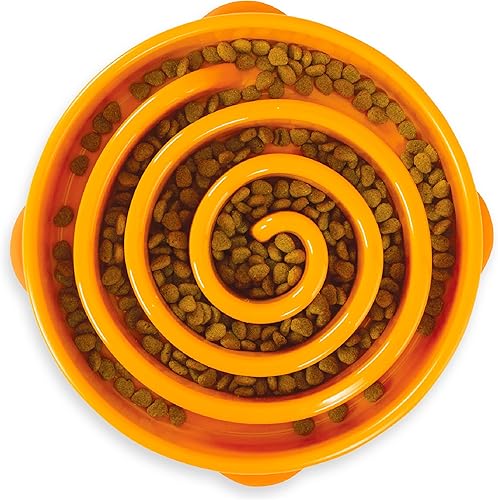
Best slow feeder bowls for dogs. Dinner gone in seconds? Slow the bowl, not the dog.
Dinner gone before the bin lid closes? Four slow feeders by eater: a maze for kibble gulpers, wide channels for short noses, a lick mat for soft food, and steel.
For a dog who eats too fast, start with the Outward Hound Fun Feeder Slo Bowl.
Its maze forces small mouthfuls, and a harder pattern is there when he catches on.
Short-nosed breeds need wider channels; soft food goes on a lick mat.
In this guide14 sections
Dinner is gone before the lid is back on the food bin. A slow feeder puts something in the way of the next mouthful: ridges, a dome or a textured mat. Four steps to set one up.
Choose by what goes in it: ridges for kibble, a textured lick mat for canned or raw dinners (see LickiMat Slomo at Amazon).
Put a first-timer on the gentlest design from Outward Hound; the tricky ones can wait.
Pour a normal portion and look: the kibble should stay below the ridge tops. Heaped above them, it needs the bigger size.
Clock one dinner in the old bowl and one in the new. More minutes at the bowl means it's doing its job.
Four bowls for four kinds of eater: the kibble vacuum, the flat face, the wet-food fan and the household that wants steel. None of them ends the stare-down at the empty bowl. Each one buys you enough time to put the scoop away first.
Wolfing dinner and then eating grass? Here is why dogs eat grass and when it is a vet call.
Pick by your dog
Gulps dinner, first slow feeder ever: the Outward Hound maze.
Pug, bulldog or Frenchie: JASGOOD, with wider channels for short noses.
Canned or raw dinners: a lick mat, and ours is the LickiMat.
You want steel, not plastic: Neater Pet Brands.
The picks side by side
Pick
Best for
The catch
Our pickOutward Hound Fun Feeder Slo
Best forFirst-time slow feeder buyers
The catchPlastic can stain with wet food.
Also greatJASGOOD Slow Feeder Dog Bowl
Best forBrachycephalic breeds (Bulldogs, Pugs, Frenchies)
The catchDeep grooves are slightly harder to clean. Keep a bottle brush by the sink.
Also greatLickiMat Slomo Slow Feeder
Best forFast eaters
The catchNot as deep as traditional bowls: holds less kibble
Our pick: Outward Hound Fun Feeder Slo Bowl
Outward Hound Fun Feeder Slo Bowl: a maze-style slow feeder. The ridges make your dog eat around them, so meals take longer.
The maze makes your dog work around the ridges, so each mouthful is smaller and dinner takes longer. That's the gap you were missing when you turned your back. It comes in several maze patterns, so you can start easy and step up. It rinses clean after dinner.
Want a crunchy reward to go with the slower dinner? See the best dog biscuits you can buy at the store.
Best for: First-time slow feeders and dogs who inhale kibble, because the patterns let you start easy and make it harder later.
The catch: Some patterns are easier than others, so a clever dog will crack the easy one fast.
Skip it if: Your dog eats wet food. The plastic can stain; the LickiMat is made for that.
Best for flat-faced breeds: JASGOOD Slow Feeder Dog Bowl
JASGOOD Slow Feeder Dog Bowl
Best for: Brachycephalic breeds (Bulldogs, Pugs, Frenchies)
Deeper ridges and wider channels, which matters when your dog's nose doesn't stick out past their face. Also a good next step for a dog who has already solved a basic maze. Anti-slip base.
Best for: Pugs, bulldogs and Frenchies, and maze graduates. The wider channels leave room for a short nose, and the deeper ridges slow a dog who beat the easy bowl.
The catch: Deep grooves take more scrubbing.
Skip it if: Your dog is very small. It comes in one size.
A raised center dome instead of a maze, in stainless steel with a weighted base. It rinses clean.
Best for: Owners who want steel over plastic and a dog who needs only a light brake. The dome pushes food to the edge, and the weighted base stays put.
The catch: A simple dome won't hold off the most determined eaters for long.
Skip it if: Your dog already beats easy mazes. Get the JASGOOD.
Four slow feeders side by side
Outward Hound Fun Feeder Slo Bowl: plastic, several patterns, roomy enough for a full kibble meal. Wet food can stain it.
JASGOOD Slow Feeder Dog Bowl: deeper ridges, wider channels, anti-slip base. One size, and the grooves need a scrub.
LickiMat Slomo: suction-backed, so it stays on the floor while he licks. Smaller meals only, since it holds less than a bowl.
Neater Pet Brands Slow Feed Bowl: stainless steel, raised center dome, weighted base, rinses clean. The gentlest brake of the four.
What to look for in a slow feeder bowl
Five things change the pick. Everything else is color.
Food type: kibble rolls through a maze. Wet food smears into deep grooves and sets there, so a flat textured mat is easier to eat from and to wash.
Nose shape: a short-nosed dog can't reach into narrow channels. Look for wide gaps between the ridges.
Pattern depth: shallow and open for a first slow feeder, deeper and tighter once your dog has the trick figured out.
A base that stays put: a dog working around ridges pushes the bowl. Anti-slip, suction or weighted bases keep dinner from touring the kitchen.
Material: plastic comes in more maze shapes but can stain. Steel rinses clean and keeps its look, with simpler shapes.
Getting your dog used to it
See all 4 pointsHide this section
First few dinners: The simplest pattern, filled with the food that gets the biggest reaction.
Whining, pawing or walking off means the jump was too big. Alternate bowls and move meals across one at a time.
Set it down in the usual feeding spot, so the bowl is the only thing that changed.
Stay in the room for the first meals. A dog who chews the ridges or tips the bowl needs a steadier base or a different design.
Still gulping? What to try next
A slow feeder that stopped working usually has one of four problems, and each has a fix.
He solved the maze: move to a harder pattern, or to the deeper ridges of the JASGOOD.
The food sits on top of the ridges: the bowl is too small for the meal. Go a size up, or serve the portion in two rounds in the same bowl.
The bowl slides or flips: set it on a rubber mat or against a wall, or switch to a bowl with an anti-slip, suction or weighted base.
He gives up and walks away: the pattern is too hard for now. Go back to the easiest one and mix in meals from the old bowl.
If he still clears the hardest bowl before you've closed the food bin, he has earned a promotion to a puzzle feeder (below).
Slow feeder mistakes that undo the work
The bowl is rarely the problem. The setup around it usually is.
Skip these
Two dogs, one slow bowl: the fast eater finishes and heads straight for the other dinner. Feed them apart, in separate rooms if needed, so the brake only works on the dog it's for.
Leaving it down between meals: an empty plastic maze looks a lot like a chew toy. Pick it up once dinner is done.
Sticky toppers in a maze: spreads dry into the corners of a ridged bowl. Keep them for the lick mat, which is built for them.
New food and new bowl in the same week: if dinner goes badly, you can't tell which one he objects to. Change one thing, wait, then change the next.
Keeping a slow feeder clean
Ridges are great at slowing food and just as good at holding on to it. Rinse the bowl right after the meal, before leftovers dry in the grooves.
Deep grooves like the JASGOOD's need a small brush; a bottle brush reaches the corners. Wet food on a lick mat comes off easiest while it is still soft. Steel rinses clean. For the dishwasher, check the care notes on the listing first.
Also great
JASGOOD Slow Feeder Dog Bowl
Best for: Brachycephalic breeds (Bulldogs, Pugs, Frenchies)
A slow feeder bowl for every meal; a puzzle feeder for dogs who need a job.
Slow feeder bowl: The whole meal goes in, ridges or a dome do the slowing. Pour, set down, done. The Outward Hound comes in several maze patterns, so you can step up the difficulty.
Puzzle feeder: The food hides in a snuffle mat or a puzzle toy, and your dog sniffs or nudges it out. More work for him, more setup for you.
Start with the bowl. If he solves the hardest maze before you've put the scoop away, he's ready for a puzzle.
When to talk to your vet
Read on (1 min)Hide this section
If your dog gulps, then vomits, coughs or seems uncomfortable after eating, mention it to your vet. Owners of large, deep-chested dogs should ask about bloat and how to feed safely. A bowl helps with speed; it isn't a medical fix.
All four do one job: they put an obstacle between the dog and the next bite. What differs is how big the obstacle is. A steel dome is a light brake, a plastic maze a firmer one, and deep ridges firmer again. A textured mat changes the game entirely, because soft food can't be gulped off it. That is why the Outward Hound leads. Most fast eaters are kibble dogs, and its patterns let you raise the obstacle as your dog catches on, without buying a second bowl. Not sure how much dinner is? See how to measure your dog's food portions.
Yes, if the bowl fits the dog and the meal. The ridges break a meal into smaller mouthfuls, so dinner takes longer. Time one meal in the old bowl and one in the new: that tells you whether it works for your dog. If the food piles over the ridges, the bowl is too small.
What is the best slow feeder for large dogs?
Pick one big enough that a full meal sits below the ridges, and check the sizes on the listing. The Outward Hound holds a full kibble meal; the JASGOOD comes in one size. If your large dog is deep-chested, ask your vet about bloat and how to feed safely.
Can slow feeders frustrate dogs?
Some dogs whine, paw or walk away at first. Start with the easiest pattern and food your dog loves, and mix in a few meals from the old bowl while he learns. If he keeps quitting, the pattern is too hard for now; go back a step.
Can I use a slow feeder for wet food?
Yes, but a flat textured mat works better than a deep maze. Wet food sticks in narrow grooves and can stain plastic. The LickiMat Slomo is made for wet food, raw food and spreads, and it holds less than a bowl, so it suits smaller meals.
How long should a meal take in a slow feeder?
There is no magic number of minutes. A good sign is a meal that lasts longer than it did in the old bowl and ends with an empty bowl, not a dog who walked off. If the time barely moved, step up the pattern.
Can puppies use a slow feeder bowl?
Yes. Begin on the gentlest pattern so a young dog gets the food out without a fight. Puppies chew, so lift a plastic bowl as soon as the meal is over. Ask your vet how much and how often a growing puppy should eat.