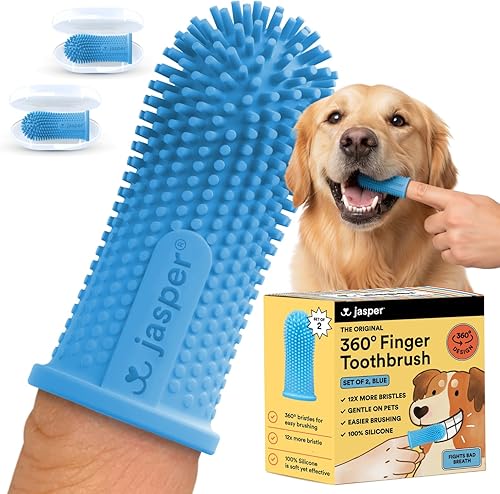
To brush dog teeth, go taste first, gums second, brush last: a Jasper 360 Finger Toothbrush for most dogs, Ark Naturals Brushless Toothpaste for a small dog who dodges brushes.
Spread it over one week.
Use dog toothpaste only, never yours (xylitol).
In this guide9 sections
Toothpaste on the ceiling and a dog under the bed? You started with the brush. Learning how to brush dog teeth goes the other way round: taste first, gums second, brush last, one small step at a time over a week.
Days 1 and 2: put a dab of dog toothpaste (never yours: some human toothpaste contains xylitol, which the ASPCA lists as dangerous to pets) on your finger and let your dog lick it off. That's it.
Days 3 and 4: lift the upper lip on one side for a second, then treat. Do the other side, then rub a paste-covered finger along the outer gums for a few seconds.
Day 5: let your dog lick paste off the brush, then touch it to one big back tooth for a second. A finger brush like the Jasper 360 Finger Toothbrush (see it at Amazon) feels less strange to beginners. Treat.
Days 6 and 7: brush small circles along the gumline of the back teeth and canines on one side. Stop after a few seconds while your dog is still calm.
Week 2 and beyond: build toward both sides, outer surfaces, every day, at the same time, like after the evening walk.
Never wrestle your dog into it: one fight makes every next try harder. The calendar is a guide, not a deadline. Your dog's body language decides when you move on.
What you need
Dog toothpaste. Never human toothpaste: some contain xylitol, which the ASPCA lists as dangerous to pets.
A finger brush or a soft dog toothbrush. Finger brushes feel less strange to beginners. Angled brushes reach the back teeth more easily.
Treats or praise for after each session.
The catch
Finger brushes wear out. The 2-pack includes a spare for when the bristles flatten.
Skip it if
You'd rather hold a handle: a soft dog toothbrush works too, and angled brushes reach the back teeth more easily.
The first week, day by day
Each session is a minute or two. Move on when your dog is relaxed at the current step. If a day goes badly, go back a step tomorrow.
Days 1 and 2: taste test
Do: Put a dab of dog toothpaste on your finger and let your dog lick it off. That's it.
Goal: You're teaching "the tube means something tasty".
Next step: Your dog walks over when the tube comes out.
Flavor: Not interested? Try another dog toothpaste flavor before you move on.
Days 3 and 4: lip lift
Lift: Gently lift the upper lip on one side for a second, then treat. Then the other side.
Gums: Then rub a paste-covered finger along the outer gums for a few seconds.
Next step: Your dog holds still for the lip lift on both sides without turning the head away.
Day 5: introduce the brush
Lick: Let your dog lick paste off the brush.
Touch: Then touch the brush to one big back tooth for a second. Treat.
Next step: Your dog licks the brush and lets it rest on the tooth.
Stuck: If the bristles are the problem, stay on the finger brush for a few more days.
Days 6 and 7: a few teeth at a time
Brush in small circles along the gumline of the back teeth and the canines on one side. Stop after a few seconds while your dog is still calm. Do the other side in the next session if needed. Brush, then browse the best dog teeth cleaning products for the rest of the routine.
Week 2 and beyond
Goal: Build toward both sides, outer surfaces, every day.
Routine: Same time every day, like after the evening walk, so it becomes part of the routine.
Front teeth: Leave the small front teeth for last. Lift the front of the lip and use the tip of the brush with light strokes.
Pace: Add one new area at a time, and keep the easy back teeth in every session so it still ends on a win.
Same time daily, after the evening walk, and brushing becomes routine, not a fight.
Body language: when to move on and when to slow down
Watch your dog, not the calendar. Some dogs fly through the week, some need two. Both end up in the same place.
Move on: loose body, soft eyes, your dog stays put or leans in and keeps licking the paste.
Slow down: lip licking with no paste around, yawning, turning the head away, ears pulled back, or the whites of the eyes showing. Stay on the current step for a few more days.
Stop for today: pulling away, freezing stiff, or a growl. Finish with something easy, like a lick of paste, so the last memory is a good one.
Plaque vs tartar: why the routine is daily
Read this sectionHide this section
Plaque is the soft film that builds up on teeth every day, and a brush wipes it off. Left alone, it hardens into tartar, the crusty yellow-brown layer at the gumline that a brush can't shift.
So the brush works on what's coming, not on what's already there. A short daily brush beats a long weekly one, and tartar you can already see is a job for your vet.
Positioning by dog size
Read this sectionHide this section
Small dogs: sit on the floor with your dog in your lap, facing away from you, or on a towel on a sofa next to you.
Medium and large dogs: sit or kneel beside your dog. Coming at the face head-on feels like a challenge to many dogs.
Any size: short, calm sessions in the same spot every day.
Sit beside your dog, never head-on: many dogs read that as a challenge.
Troubleshooting
Your dog clamps their mouth shut: you don't need it open. Lift the lips and brush the outer surfaces.
Your dog pulls away every time: go back to the last step that went well, and keep sessions shorter.
Your dog growls or snaps: stop. That can mean fear or pain. Get a vet check before you try again.
The gums bleed: a little pink on the brush can mean the gums are inflamed. Brush more gently and book a vet visit if it keeps happening.
You missed a few days: no need to start over at day 1. Start one step before where you stopped, and move back up as soon as your dog is relaxed again.
Your dog just had a dental cleaning or a sore mouth: ask your vet when to start brushing again, then pick up at the taste step so the first sessions back are easy.
Growl or snap? Stop, and get a vet check before you try again.
What if my dog won't let me brush?
Some dogs, especially seniors with sore mouths, never accept a brush. Ask your vet what to use instead, and keep working on handling. A soft brushless chew with a toothpaste coating is one gentle add-on for small dogs, but nothing works quite like the brush. Our dog dental care guide explains where chews fit.
Common mistakes
Read this sectionHide this section
Skip these
Wrestling your dog into it: one fight makes every next try harder. Go taste first, gums second, brush last.
Human toothpaste: use dog toothpaste. Some human toothpaste contains xylitol, which the ASPCA lists as dangerous to pets.
Forcing the mouth open: you don't need it open. Lift the lips and brush the outer surfaces.
Pushing on through a growl or snap: stop. That can mean fear or pain, so get a vet check before you try again.
Long sessions: keep each one to a minute or two. When you start brushing, stop after a few seconds while your dog is still calm.
Scrubbing hard: small, gentle circles at the gumline do the job. Pressing harder doesn't shift tartar, and sore gums turn tomorrow's session into a fight.
Quick answers
How often should I brush?
Daily, at the same time, is the routine to build. Ask your vet how often your dog's teeth need it.
Can brushing remove tartar that's already there?
No. Tartar that's already there is a job for your vet. Brushing is for what builds up next.
How long should I brush my dog's teeth?
A minute or two per session once your dog is used to it. While you're still building up, stop after a few seconds, before your dog gets restless.
Do I need to brush the inside of the teeth?
Start with the outside, the cheek side you reach by lifting the lips. That's the side this plan covers, and it works with the mouth closed. Ask your vet whether your dog's inner surfaces need attention too.