Best no-pull dog harnesses. Dog drags you on walks? A front-clip harness turns him back.
Six no-pull harnesses with a chest ring, sorted by dog and walk: the all-rounder, the hardest puller and a first harness, plus a day-one fit setup and care checks.
Clip the leash to the chest ring, never the back one. Snug the straps until two fingers slide under each.
Leash tight? Stop. Leash slack? Walk on and hand him a treat.
Six picks, one per kind of walk: the all-rounder, everyday walks, a first harness, the hardest puller, car rides and a big trail dog. Every one has a front ring; they differ in padding and hardware.
How does a no-pull harness work?
A no-pull harness moves the leash ring from his back to his chest. When he pulls, the leash turns his chest back toward you, so charging ahead gets him nowhere. A back clip gives him nothing to turn against. Pair it with treats for a slack leash, and the habit sticks.
What changes at the end of that tight leash:
Front-clip attachment: When he pulls, the leash swings him sideways toward you instead of letting him charge forward
Chest tightening: Some designs tighten gently across the chest when he pulls
Weight distribution: A harness spreads force across the chest and shoulders instead of the throat
Dual clips: A front ring for training and a back ring for easy walks
What is the best no-pull harness for dogs that pull?
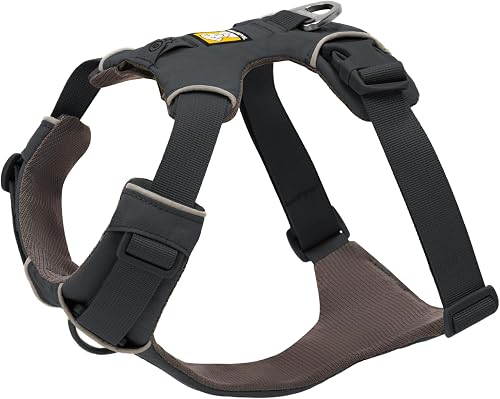
Our pick is the Ruffwear Front Range: a chest ring, foam-padded panels and four points of adjustment, so it stays put on long walks. For the dog who drags you anyway, the 2 Hounds Design Freedom adds a back ring, a martingale loop and stainless steel hardware. Whichever you choose, buy it by chest girth, not by the number on the scale.
1.Dogs who pull, and owners who walk a lot: Our pick: Ruffwear Front Range all-day adventure harness
Why it's here: clipped at his back, the leash lets him tow you. This front ring turns him back toward you instead. Foam-padded chest and belly panels, plus a back ring for the easy days.
Four adjustment points for a close fit
Reflective trim and an ID tag slot
On paper (maker's page): foam-padded construction, four points of adjustment, an aluminum V-ring on the back and reinforced webbing at the chest.
The catch
Four adjusters to set, and hand wash only. Left loose, it twists, the front ring slides toward the armpit and he keeps pulling, so snug every strap on the first fitting. Not sure which type fits your walk? See how to choose a dog harness or leash.
Skip it if
Your walks are short and easy and you want the simplest harness to clip on. The rabbitgoo covers that.
Dual leash attachment points: front clip for no-pull training, back clip for casual walks
Four adjustable straps
Quick-snap buckles, no stepping in
On paper: Front and back clips, reflective straps, breathable mesh and quick-snap buckles.
The catch: The buckles are plastic, so a very strong puller needs something tougher, and sizing runs slightly large.
Skip it if: Your dog hits the end of the leash at full power. Plastic buckles are the weak point there; the 2 Hounds or the AUROTH has metal hardware.
3.Best for beginners: PetSafe Easy Walk no-pull dog harness
Why it's here: his first harness, while he learns a slack leash keeps the walk going. A front chest ring turns him to face you, and a martingale loop keeps it from tightening at the throat.
Best forFirst-time harness users and dogs learning to walk on a loose leash
The catch
It can slip sideways on barrel-chested dogs, and short-haired dogs need an undershirt so the straps don't rub.
On paper: A front chest ring, a martingale loop, a quick-snap shoulder buckle and a lightweight, breathable build.
The catch: It can slip sideways on barrel-chested dogs, and short-haired dogs need an undershirt so the straps don't rub.
Skip it if: Your dog has a deep, barrel chest. A harness that slides sideways can't turn him back toward you.
4.Strong pullers who need more control: 2 Hounds Design Freedom no-pull dog harness
Why it's here: for the dog who still drags you past the third house. Front and back clips, a back loop that tightens gently when he pulls, and a velvet-lined chest strap. No leash in the box.
Best forStrong pullers who need more control
The catch
More straps and two leash points mean more to sort out on a dog who won't hold still, so the first few fittings take patience.
On paper (maker's page): stainless steel hardware, a Swiss Velvet lining behind the front legs, front and back connection points and a martingale loop.
The catch
More straps and two leash points mean more to sort out on a dog who won't hold still, so the first few fittings take patience.
Skip it if
Your dog won't stand still while you fit straps. The quick-snap PetSafe goes on faster.
5.Dogs who ride in the car a lot: Kurgo Tru-Fit smart dog walking harness
Why it's here: some walks end in the car. A front D-ring walking harness that doubles as a car harness, seatbelt tether in the box.
Best forDogs who ride in the car a lot
The catch
The seatbelt tether is short for some cars, and the front clip sits low on smaller dogs.
Skip it if
You have a small dog and want the front ring to do the steering.
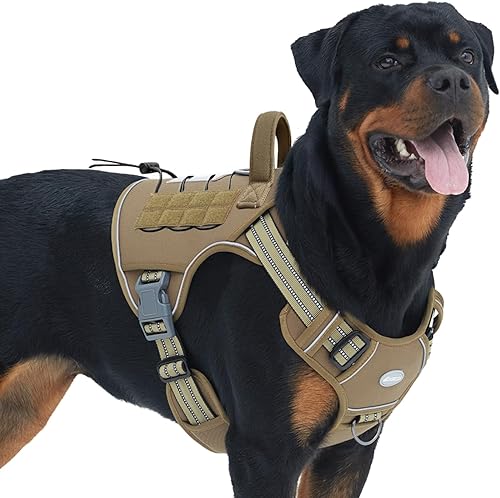
It's heavier than a standard harness, and the tactical look isn't for everyone.
Skip it if
Your dog is small or medium and walks around the block. All that nylon is weight he doesn't need.
Which harness for which dog, at a glance
Match the walk you have, not the dog you wish you had:
Pulls, and you walk a lot: Ruffwear Front Range (padded panels, front and back rings).
Medium to large dog, everyday walks: rabbitgoo No-Pull (reflective straps, breathable mesh).
First harness, still learning loose-leash walking: PetSafe Easy Walk (chest ring, martingale loop).
Drags you anyway: 2 Hounds Design Freedom (two leash points, a back loop that tightens gently).
Walks and car rides: Kurgo Tru-Fit (front D-ring, seatbelt tether).
Large dog, outdoor work: AUROTH Tactical (900D nylon, metal clips, MOLLE panel).
The six picks side by side:
Pick
Best for
Leash rings
Build
Ruffwear Front Range
Best forPullers who walk a lot
Leash ringsFront and back
BuildPadded chest and belly, 4 adjusters
rabbitgoo No-Pull
Best forEveryday walks, medium to large dogs
Leash ringsFront and back
BuildPlastic quick-snap buckles, runs slightly large
PetSafe Easy Walk
Best forA first harness
Leash ringsFront only
BuildMartingale loop, quick-snap buckle
2 Hounds Design Freedom
Best forStrong pullers
Leash ringsFront and back
BuildVelvet-lined chest strap, metal hardware
Kurgo Tru-Fit
Best forWalks and car rides
Leash ringsFront only
BuildSeatbelt tether in the box, 5 adjusters
AUROTH Tactical
Best forBig working dogs
Leash ringsFront and back
Build900D nylon, metal clips, MOLLE panel
How do you choose a dog harness for pulling?
Tape measure first, then the job. A chest ring is the one feature every puller needs. Past that, the hardest pullers want metal hardware and a back control loop, and short-coated dogs want padding wherever a strap crosses bare skin.
Measure your dog first: a harness bought by weight or guesswork is the usual reason it twists, gaps or rubs
Strong puller? Look for metal hardware and a back control loop, like the 2 Hounds.
Out before sunrise or after dark? Pick reflective trim (Ruffwear, rabbitgoo) and add a clip-on light. The AUROTH's MOLLE panel can carry one.
One ring or two? A second ring on the back lets you move the leash there once he holds a slack leash, so the harness outlasts the training.
Read the exchange terms before you order. Fit is the usual reason a harness goes back, so keep the tags on until the first walk.
Short coat? Spend on padding (Ruffwear) or a lined chest strap (2 Hounds). Bare webbing is what chafes.
Makers disagree on the in-between size, so read the page for your pick. Ruffwear measures around the widest part of the rib cage and says to choose the larger size. 2 Hounds Design measures around the widest part of the chest, just behind the front legs, and says to choose the smallest size that still fits comfortably.
Best no-pull harness by dog size: small, medium and large
Small dog: start with the lightest, the PetSafe Easy Walk, and match his chest to the listing's size chart. Medium dog: the rabbitgoo. Big dog who drags you anyway: the 2 Hounds Design Freedom. Any size: buy by the chest, not the scale.
Small dogs
Lightest pick: The PetSafe Easy Walk. It is lightweight, snaps on at the shoulder and turns him to face you from the chest ring. Measure his chest and match it to the listing's size chart first.
Skip the rabbitgoo and the AUROTH: both listings are the large size. The Kurgo's front clip sits low on smaller dogs, so it turns him less.
Medium dogs
Everyday walks: The rabbitgoo No-Pull, front and back clips and quick-snap buckles. It runs slightly large, so check the fit before long walks.
Rides in the car too: the Kurgo Tru-Fit. Walk to the car, clip on the seatbelt tether, and he rides in the same harness.
Deep, barrel chest: skip the PetSafe Easy Walk, which can slip sideways on that build.
Large dogs
Strong puller: The 2 Hounds Design Freedom, with two leash points, a back loop that snugs up when he pulls and stainless steel hardware.
Big working or outdoor dog: the AUROTH Tactical, large size, 900D nylon, metal clips and a MOLLE panel for lights and pouches.
Over 75 lb and riding in the car: the Kurgo is built for dogs up to 75 lb, so it is not his car harness.
Fit it right on day one: the setup that makes the front ring work
A no-pull harness only steers when the ring sits in the middle of his chest. Set it up once, properly, before the first real walk:
Loosen every strap before it goes on, so you tighten into the fit instead of wrestling him into a small harness.
Keep treats in your pocket. One as it goes over his head, one for each buckle, and the harness starts to mean a walk.
Center the chest ring on his breastbone. Off to one side, a pull spins the harness instead of turning the dog.
Keep the strap behind the front legs clear of the armpit. That fold is where rubbing starts.
Walk him around the house, then check again. Webbing settles as he moves, and a ring that drifted sideways points to the loose strap.
Two leash rings? Clip to the front one for every walk while he is learning. The back ring is for later, once the leash hangs in a loose J most of the way.
Front clip or back clip for no pulling?
Front clip while he is still steering, back clip once the leash hangs slack. Which ring you use depends on the walk:
Training walks: Front ring. Every lunge at a squirrel ends with him facing you instead of the squirrel.
Easy strolls with a dog who already keeps the leash loose: back ring, which tangles less around his front legs.
Dual-clip harnesses give you both options: use the front clip during training, switch to back for relaxed outings
Head halters take a longer adjustment period, so start with a front-clip harness
Front clip only: PetSafe Easy Walk (chest ring) and Kurgo Tru-Fit (front D-ring). Front and back: Ruffwear Front Range, rabbitgoo, 2 Hounds Design Freedom and AUROTH.
Still pulling in a no-pull harness? Check these first
Arm still out straight in a no-pull harness? It's usually clipped wrong or fitted loose. Work down this list before you buy another one:
Back ring: On a dual-clip harness, the back ring gives a puller nothing to turn against. Move the leash to the front.
Twisting: It's loose, so the front ring slides toward the armpit and the turn never happens. Tighten every adjustment point, then check how a dog harness should fit.
Rubbing: Loosen that strap a notch, and look at a padded pick (Ruffwear) or a velvet-lined chest strap (2 Hounds). Short coat? An undershirt helps.
Retractable leash: It keeps the line tight, so pulling still pays off with more ground. Use a fixed leash while he learns.
Reward the slack leash and skip the yank. The American Veterinary Society of Animal Behavior's 2021 position statement recommends only reward-based training methods, and its 2025 board statement lists leash corrections among the aversive tools. A harness manages the pull; the treats and the stop-and-go teach him what to do instead.
Does a no-pull harness hurt your dog?
Not at the throat: a front-clip harness spreads the pull across his chest and shoulders. When one does hurt, it is the fit. Check where it rubs:
Look under the front legs when you get home, where long wear rubs. Rubbing? The fix is in the checklist above.
Fit matters more than the harness label. In a Veterinary Record study of nine dogs on a treadmill, the non-restrictive style cut shoulder extension 2.6 degrees (walk) and 4.4 degrees (trot) more than the restrictive style. A preprint review of three studies, not yet peer reviewed, found reductions of up to 8 degrees for a chest strap and up to 10 degrees for a Y-shaped harness. So watch how he moves in the first week.
If he moves stiffly, limps or flinches when you put it on, take it off and ask your vet before the next walk.
Harness care: washing, wear checks and when to replace it
A harness that takes a strong puller every day wears at the same few points. Look there before a buckle gives on a busy road:
Mud and puddles: Rinse the webbing and let it air dry before the next outing. The Ruffwear is hand wash only; follow the care label on the others.
Buckles: Squeeze each one and look for white stress lines or cracks. Plastic hardware (the rabbitgoo) is the part to watch on a dog who lunges.
Webbing and stitching: Run each strap through your fingers. Fraying where the leash ring attaches, or a loose stitch, means a new harness rather than a repair.
Re-fit after any change: a growing puppy, a winter coat coming in or shedding out, weight up or down. The harness that fit in spring can gap by December.
Giving a no-pull harness as a gift
See the 6 pointsHide this section
A harness is a good gift for a dog who pulls, as long as it fits. Get one number first: his chest girth. Then match it to the maker's size chart.
Can't measure without spoiling the surprise? Check the exchange policy and tuck in a gift receipt, in case it doesn't fit. First harness: the PetSafe Easy Walk. A dog who walks a lot: the Ruffwear Front Range.
New puppy: Pair the first harness with our new puppy starter kit, which covers week one: crate, cleanup and the first chew.
Past pulling: Our harnesses and walking hub adds a long line for recall work and a hands-free leash for runners.
We read each maker's specs for where the leash clips, how many straps adjust and what the hardware is made of, then sorted the picks by job. Every pick names its catch. Our full method: how we pick.
Verdict: Ruffwear Front Range for most pullers, 2 Hounds Design Freedom for the hardest
See the 5 pointsHide this section
Start with the Ruffwear Front Range. The chest ring does the steering while he learns, the back ring takes over once he has earned it, and the foam padding is there for the long days. The catch: four adjusters to set up on day one, and it's hand wash only.
Not that dog? Pick by the walk you actually have:
Short, easy walks: the rabbitgoo No-Pull, the simplest one here to clip on.
Wriggles while you fit straps: the PetSafe Easy Walk, which snaps on at the shoulder.
Still dragging you: The 2 Hounds Design Freedom, with two leash points and a back loop that tightens gently.
The walk ends in the back seat: the Kurgo Tru-Fit, which takes the seatbelt tether.
A big dog on trails: the AUROTH Tactical, with metal clips and room for a light.
Yes, as a tool rather than a cure. A front clip moves the leash to his chest, so a pull turns him back toward you instead of getting him anywhere. The AVSAB's 2021 position statement recommends only reward-based training, so pair the harness with treats for every slack-leash step.
Can my dog wear a no-pull harness all day?
Most are made for walks, not all-day wear. Long wear rubs, especially under the front legs, so take it off at home unless it's built for all day. Ruffwear pads the Front Range and sells it as an all-day harness. Not sure the fit is right? See our guide to fitting a dog harness.
What size harness does my dog need?
Wrap a soft tape around the deepest part of his ribcage, right behind the elbows, and read that number against the maker's size chart. The rabbitgoo runs slightly large.
Are no-pull harnesses safe for dogs?
A well-fitted one keeps the pull off his throat and spreads it across the chest and shoulders. Fit is the part that matters: the shoulder-movement research is in the section on whether a harness hurts. Check under the front legs after walks, and ask your vet if he moves stiffly or seems sore.
Harness or head halter for a dog that pulls hard?
Start with a front-clip harness. A head halter steers from the nose, and dogs need longer to get used to one. Keep it as the next step for a dog who still drags you after the fit and training checks on this page, and introduce it slowly with treats.
How do you use a no-pull harness?
Fit it first, snug but with room to slide a finger or two under each strap. Clip the leash to the front ring, not the back. When the leash goes tight, stop. When it goes slack, walk on and reward him. The harness turns him toward you; the rewards teach him to stay there.
What's the best no-pull harness for a large dog that pulls?
For a big, strong puller, the 2 Hounds Design Freedom: two leash points, a back loop that tightens gently and a velvet-lined chest strap. For a large dog who works outdoors, the AUROTH Tactical, with 900D nylon and metal clips.
Can a puppy wear a no-pull harness?
Yes, if it fits. Measure his chest, check it against the maker's smallest size, and re-check the fit as he grows, since a harness that fit last month can rub or slip. Pair it with loose-leash training from the start.
What's the best thing to stop a dog from pulling?
A front-clip harness plus one rule: when the leash goes tight, you stop; when it goes slack, you walk on and reward him. The front ring turns him toward you, and the rewards teach him to stay there. For most dogs, start with the Ruffwear Front Range.
Why do some dog trainers not recommend harnesses?
A back-clip harness gives a puller nothing to turn against, so he leans into the chest strap and keeps going. That is the harness to skip for a puller. A front ring turns him back toward you, and every pick on this page has one.
Are front-clip harnesses good for small dogs?
Yes, when the ring sits at the chest. On a small dog a ring that sits low turns him less, which is the Kurgo's catch. The PetSafe Easy Walk is the lightest pick here and snaps on at the shoulder; measure his chest and check the listing's size chart first.
What size harness does a 30 lb dog need?
Size him by his chest, not the 30 lb on the scale. Two dogs of the same weight can need different sizes. Between sizes, Ruffwear says to choose the larger size and 2 Hounds Design the smallest that still fits comfortably.
What dog harness should I avoid for pulling?
A back-clip-only harness, if he already pulls. Nothing at the chest turns him, so he leans in and keeps going. All six of our picks have a front ring.
Can I use a retractable leash with a no-pull harness?
Not while he is learning. A retractable leash always keeps some tension on the line, so he never feels the difference between pulling and walking nicely, and the front ring has less to work with. Use a fixed leash for stop-and-go walks and save the long line for recall practice in open space.
How soon does a no-pull harness work?
The mechanics change on the first walk: a pull swings him sideways instead of forward. The habit is slower, and it comes from you. Stop when the leash goes tight and reward the slack on every walk, not only in practice sessions, and the harness has less to do over time.
Why does my dog's harness twist to one side?
It is loose, or the ring is off center. Set the chest ring on his breastbone, snug each strap and look again after a lap of the house. Still twisting on a deep chest? Pick a harness with more adjustment points, like the Ruffwear (four) or the Kurgo (five), and skip the PetSafe, which can slip sideways on that build.
Should my dog still wear a collar with a no-pull harness?
Keep a flat collar on for his ID tags, but clip the leash to the harness, never the collar, so the pull stays off his throat. If he goes out in the harness alone, the Ruffwear has an ID tag slot of its own.