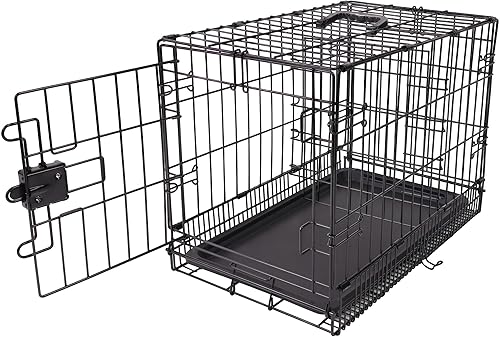
Buy one crate, not one per growth spurt: the MidWest iCrate is a folding wire crate in 6 sizes, with a divider panel so a puppy's crate grows with the puppy.
Best for: First crates and puppies who need a crate that grows with them
Best for: First crates and puppies who need a crate that grows with them
The catch: The plastic tray can slide if you don't secure it, and the wire rattles with a restless dog.
Buy one crate, not one per growth spurt: the MidWest iCrate is a folding wire crate in 6 sizes, with a divider panel so a puppy's crate grows with the puppy. Secure the plastic tray so it doesn't slide. For car trips, the EliteField soft crate folds flat.
In this guide
Watch out
Don't buy a crate big enough to roam in for a puppy you're house training. If there's room to pee at one end and sleep at the other, many puppies will. Set the divider so there's just room to stand, turn and lie down.
How to size a crate
Your dog should be able to stand up, turn around and lie down stretched out. Measure, then add a little:
Length: Nose to the base of the tail, plus 2 to 4 inches.
Height: Floor to the top of the head while sitting, plus 2 to 4 inches.
Puppy: Buy the adult size with a divider panel and move the panel as it grows.
Between sizes: Size up. A divider makes a big crate smaller; nothing makes a small crate bigger.
Our three picks: wire for home, foldable wire for a second room, soft for trips
11.Best Overall: MidWest Homes for Pets iCrate
The MidWest iCrate is the crate most dogs need. It comes in 6 sizes with single or double doors, includes a divider panel, folds flat, and has a plastic pan to protect the floor.
The catch: the wire is thinner than premium brands and the latch is basic, so it's not for a strong escape artist.
33.Car rides, visits and calm dogs who want a cozy den: Best Soft-Sided: EliteField 3-Door Folding Soft Dog Crate
The EliteField is the travel crate. It's far lighter than wire, has mesh doors on the front, side and top, and folds flat into a carrying bag; a fleece bed comes with it.
Best for: Car rides, visits and calm dogs who want a cozy den
The catch: A chewer or escape artist will get through the fabric.
Skip it if: Your dog chews fabric or tries to escape. Soft sides aren't made for that; use a wire crate like the MidWest iCrate.
The catch: a chewer or escape artist will get through the fabric. Use it for calm dogs and trips, not as the everyday crate.
Wire, plastic or soft-sided?
Wire for home and training, plastic for a dog who wants a den or flies, soft-sided for trips. Taking the crate on the road? See our car safety and seat protection picks.
Wire: the most airflow and visibility, and dividers for puppies.
Plastic: enclosed and den-like; a good fit for anxious dogs and airline travel.
Soft-sided: the lightest to carry, not for chewers.
Furniture-style: doubles as an end table, for owners who want the crate to blend in.
Crate training that works
Never use the crate as punishment. It has to be the place good things happen.
Leave the door open with treats inside and let your dog go in on its own.
Feed meals in the crate.
Close the door for minutes, not hours, while you're in the room. Then build up.
Put the crate where the family hangs out. A crate in a far room feels like exile.
Give a safe chew or a stuffed KONG, and drape a blanket over a wire crate for a den feel.
As a general rule, no more than 6 to 8 hours for an adult. For puppies, a common rule of thumb is age in months plus one in hours, so about 4 hours at 3 months. Exercise and a potty break before and after.
Should I crate my dog at night?
Yes, if the crate was introduced well. Put it in or near your bedroom so your dog isn't alone.
What if my dog cries in the crate?
Usually the crate came too fast; go back to meals and treats inside with the door open. Drooling, panic or injuring itself to get out can mean separation anxiety, so talk to your vet or a trainer.
Our verdict
Buy the MidWest iCrate in your dog's adult size and use the divider for the puppy months. Choose the Amazon Basics crate for a second room and the EliteField for travel.